Level 1 · Your field
Spiritual business ideas that keep your depth, and how to choose one
There are more ways to offer spiritual work than “book a session.” Here are the formats I see working for practitioners, and a simple way to pick the one that fits you right now.
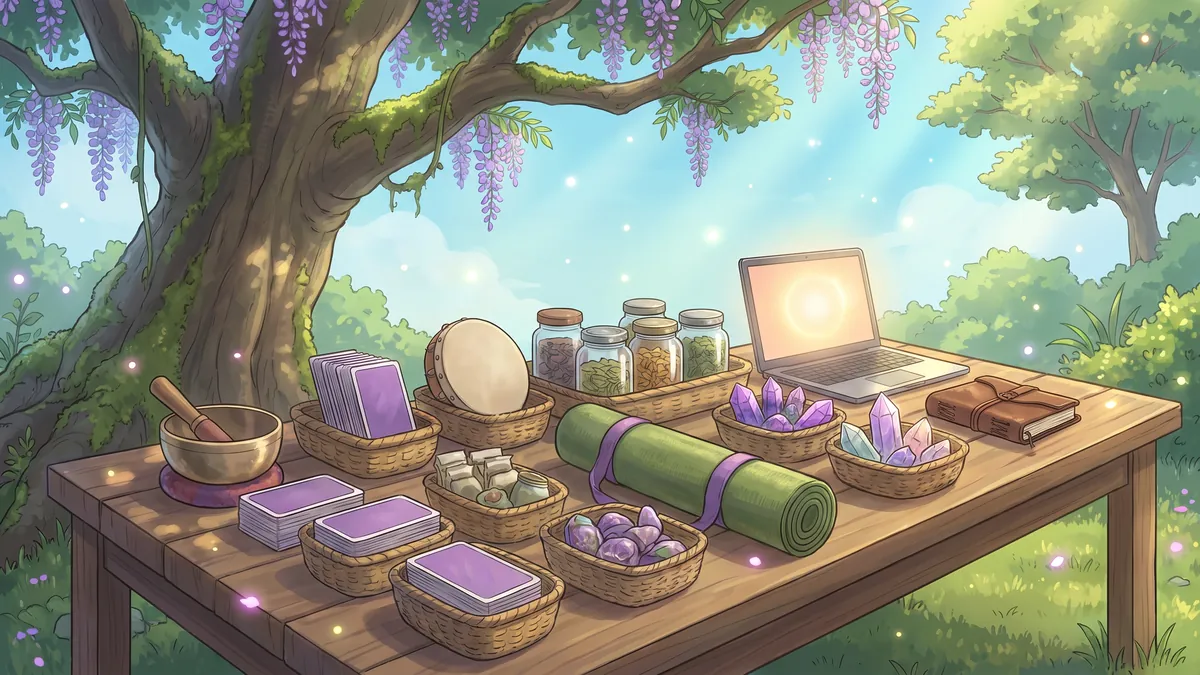
When people search for spiritual business ideas, they often find lists of products: candles, crystals, oracle decks. Those can be lovely businesses. But if you're a practitioner, the more interesting question is a different one: In which form can the work I already do reach people?
Your field stays the same. The format is the door.
Ten spiritual business ideas
1. One-to-one sessions
The classic, for good reason: Reiki, shamanic journeys, energy work, intuitive readings, spiritual guidance. Many of these work online as well as in person. One-to-one work is the most personal and the easiest to start, but it's also tied to your time.
2. Small group circles
A regular circle of six to twelve people, online or in a room. Meditation, ritual, sharing. Groups use your time more gently than one-to-one work and create something one-to-one work can't: people meeting each other.
3. Workshops and live events
A focused theme for an evening, a day or a weekend. Good as a first door, because people can experience your work without committing to much.
4. Initiations and attunements
In traditions like Reiki, initiations are a natural format. They carry weight because they open a practice for people, and they're often the beginning of a longer path with you.
5. Ritual services
Ceremonies for transitions: new homes, partings, seasonal turning points, blessings. Often overlooked, and deeply meaningful for the people who find them.
6. Recorded offerings
Guided meditations, recorded practices or short programs people can use at home. They let your work reach people in other time zones and keep working while you sleep.
7. Written work
Written readings, letters, guides or a newsletter people pay for. A good fit if words are where your intuition flows most easily.
8. Retreats
Several days away, often in nature. Intense to organize, but for many practitioners the most fulfilling format, and a strong experience for the people who come.
9. A membership or community
A space people belong to over months or years: regular gatherings, a library of practices, exchange with others. It grows slowly and carries steadily once it's alive.
10. Collaborations
Partnering with yoga studios, wellness centers, therapists or other practitioners. A shared audience is often the gentlest way to be introduced to new people.
How to choose your first idea
Don't choose the idea that sounds most profitable. Choose the one that fits. These questions help:
- Which format is closest to how you already work? Start where you have experience.
- How much energy do you have right now? A retreat is wonderful and very demanding. A monthly online circle might be the better first step.
- Who is your one person, and what would be easiest for them to say yes to? Often that's a workshop or a single session, not a six-month program.
- What should stay visible behind the door? Whatever you choose, your field should still be recognizable in it.
One clear door beats ten half-open ones.
Many of us are broad. That isn't a lack of focus. It just means you can have several doors into the same room. Open one at a time, and let the next one follow when the first one is working.
Online, in person or both
Most of these ideas work online, and many work best as a mix: an online circle for continuity, an in-person event a few times a year. When I had to move my own work online during the lockdowns, I was surprised how much of it carried through a screen. Not everything, but more than I expected.
Where AI fits into each idea
AI won't run your circle or hold your ritual. It can help you describe the format clearly, write the event page and the reminder emails, prepare handouts, and turn what you said in a workshop into follow-up material. I wrote about the boundaries I keep in AI for spiritual entrepreneurs.
If you're still sorting out which door is yours, the free Calling Compass is a good place to start.
Frequently asked questions
What are good spiritual business ideas?
Formats that grow from a practice you already have: one-to-one sessions, small group circles, workshops and live events, initiations or attunements, ritual services, recorded meditations or programs, written readings, retreats, a membership community, and collaborations with studios or other practitioners.
Which spiritual business ideas work from home?
Online one-to-one sessions, online circles, recorded meditations and programs, written readings and an online membership all work well from home. You need a quiet space, a reliable internet connection and a simple booking and payment setup.
How do I choose the right spiritual business idea?
Pick the format closest to how you already work, that fits your current energy, and that is easy for the one person you serve to say yes to. Start with one idea and add others once it's working.
Can I offer several spiritual services at once?
Yes, eventually. Think of them as several doors into the same room. It usually works better to open one door clearly first, and add the next when the first one runs smoothly.
Is a spiritual membership a good idea for beginners?
It can be, but memberships grow slowly and need regular care. Many practitioners start with sessions or a workshop and build a community once they have people who want to stay.